
Paul in Ephesus: A Warning to Leaders[1]
In Acts 19:10, we are told Paul spent two years in Ephesus, preaching the gospel. So he’s there for two years, seeing people converted and seeing this church planted. Then a chapter later in the book of Acts, he’s traveling. He’s on his way to Jerusalem. He doesn’t want to be delayed, and so he summons the elders from the church in Ephesus to come to him at Miletus, and he gives them this parting message. In the midst of those comments, he says to them in Acts 20:29–30, “I know that after my departure fierce wolves will come in among you, not sparing the flock.” He’s probably alluding to the way that Jesus spoke of wolves in sheep’s clothing (Matt 7:15). Luke then records in Acts 20:30 that Paul says, “From among your own selves will arise men speaking twisted things to draw away the disciples after them.” He finishes his comments and tells them they will not see him again; they weep over him, most broken over the fact that they won’t see Paul again.
So there’s a great church planted by the apostle Paul himself, with elders he likely invested in. He tells those men that from among them will arise people speaking twisted things. When we come to 1 Timothy, Paul must address what has actually happened.
The Problem in Ephesus: Shipwrecked Faith and False Teaching
The problem is that exactly what Paul said would happen has happened: some elders have made a shipwreck of the faith. As Paul says in 1 Timothy 1:19–20, “Rejecting faith and a good conscience, some have made shipwreck of their faith, among whom are Hymenaeus and Alexander, whom I have handed over to Satan so that they may learn not to blaspheme.” Those two men may have been elders in Ephesus and are likely significant sources of the false teaching Paul addresses in First Timothy. Men from the church’s leadership have done what Paul warned against in Acts 20:30 — men from among them have spoken twisted things.
In 1 Timothy 1:5–6 Paul describes certain persons swerving from a pure heart, a good conscience, and a sincere faith. The sincere faith in Christ produces confidence that sins have been paid for, and by the Spirit there’s regenerating power that results in a purified heart, new desires, and righteous impulses. The true gospel brings about a pure heart and good conscience (1 Tim 1:5). But these elders have swerved and wandered into vain discussion (1:6); they don’t even understand the Bible they profess to teach (1:7–11). Near the end of the letter (1 Tim 6:20–21) Paul warns Timothy to “guard the deposit” and “avoid the irreverent babble and contradictions of what is falsely called knowledge” — probably Gnosticism. “By professing” such knowledge, “some have swerved from the faith” (6:21).
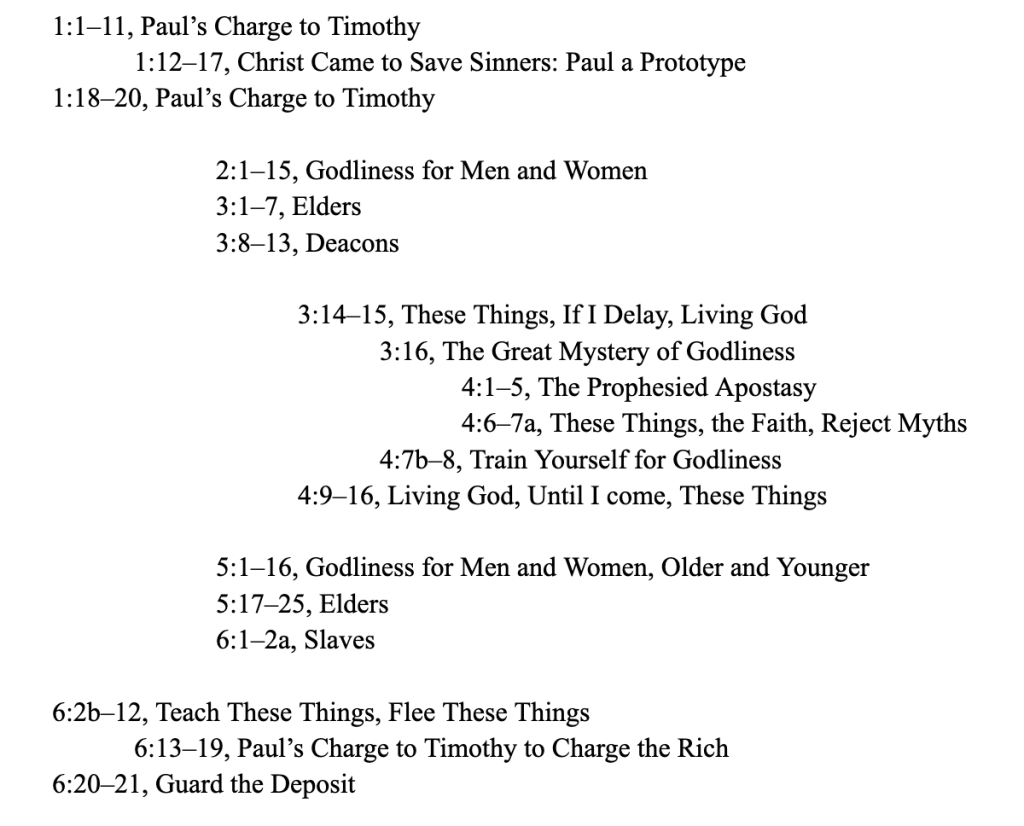
Paul entrusts Timothy with a charge (1:18) to advocate the true gospel in Ephesus. The leadership’s departure from the gospel explains the need for instruction on proper doctrine and order throughout the letter: in prayer (chapter 2), in conduct (chapters 2–3), in relations between men and women (2:9–15), in how to treat elders and widows (chapter 5), and in leadership qualifications (chapter 3).
The Chiastic Structure of 1 Timothy
Qualifications for Elders
1 Timothy 3:1–7 addresses the problem of elders who have swerved from the faith by laying out qualifications for elders. In the corresponding passage (1 Tim 5:17–25) Paul gives instructions on adequate compensation for elders and on discipline. Paul is seeking to clean up disorder, reorder thinking and living, and set standards so the church can fulfill the Great Commission. To make disciples and plant churches, Ephesus — like every church aspiring to be healthy — needs qualified elders.
This passage reads as a response to specific violations: everything mentioned here has been — and is being — violated. Paul has to declare what elders must be and must not be so that the church receives leaders who will maintain the true gospel.
Structural Summary of 1 Timothy 3:1–7
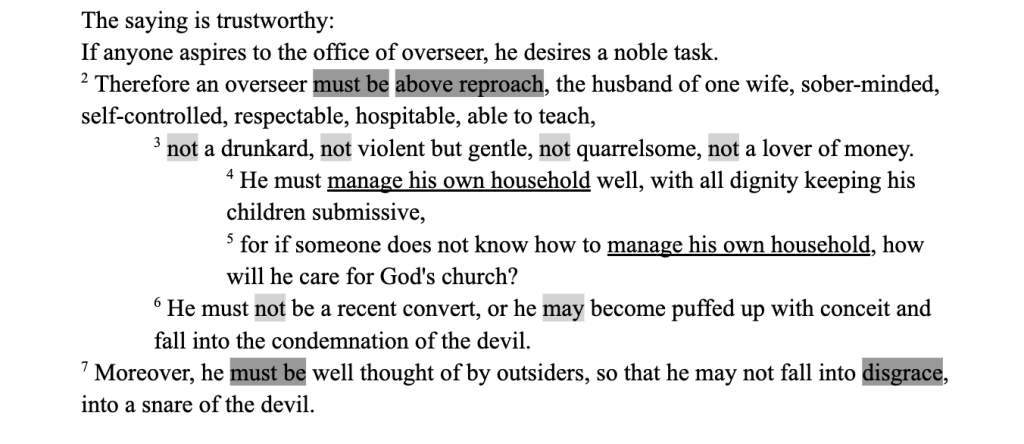
Paul starts in verses 1–2 emphasizing that leaders among the congregation need to be “above reproach” within the church and “well thought of” outside (v.7). He lists positive qualifications in verse 2: husband of one wife, sober-minded, self-controlled, respectable, hospitable, able to teach. He then lists negative qualities in verse 3: not a drunkard, not violent, not quarrelsome, not a lover of money — each corresponding to the positives. Verse 6 warns against appointing recent converts, lest they become puffed up with conceit. Verses 4–5 center on household management: elders must lead their families well so they can lead the church well. Verse 7 finishes with reputation among outsiders so they do not fall into disgrace and the snare of the devil.
The Chiastic Structure of 1 Timothy 3:1–7
“The Saying is Trustworthy” and the Gospel Link
Paul opens with “The saying is trustworthy,” an expression he uses only five times across the pastoral letters. The first occurrence (1 Tim 1:15) states, “Christ Jesus came into the world to save sinners” — a direct reiteration of the gospel. The gospel is not ancestral pedigree or secret myths (1:4); it is that Christ saved sinners by his life, death, resurrection, ascension, and intercession. In 1:13 Paul says he received mercy because he acted ignorantly and in unbelief — showing that he deserved condemnation but received mercy. This establishes that elders are to be gospel advocates: people who maintain and proclaim the true gospel.
Thus, the “saying is trustworthy” connects to the aim of qualifying elders: the church needs elders who can advocate the true gospel and keep the congregation from being led astray.
Aspiring to the Office of Overseer: Desire and Calling
“If anyone aspires to the office of overseer, he desires a noble task.” The word translated “aspires” refers to internal desire and seeking to become qualified — not to an extraordinary audible call like Moses’ burning bush or Abraham’s specific command. Paul is not referring to sensational calls; he speaks of aspiration that won’t let one rest: a desire to serve, to get equipped, to be placed in position to serve.
The same Greek word appears in 1 Timothy 6:10 (translated “craving” with reference to the love of money), suggesting a contrast: some crave riches and wander from the faith, while elders should aspire to serve and must not be lovers of money. Aspiring to oversight is affirmed by Paul as noble, provided pride is checked.
Cotton Mather (“The Office of the Christian Ministry”) rightly contends the Christian ministry is
the most honourable and important, that any man in the whole world can ever sustain; and it will be one of the wonders and employments of eternity, to consider the reasons, why the wisdom and goodness of God assigned this office to imperfect and guilty man!
Aspiring to this office, when rightly understood, is therefore a noble ambition.
Qualifications: “Must Be Above Reproach” and “Well Thought Of”
This brings us to Paul’s primary imperatives, which he places first and last: an overseer must be “above reproach” (v.2) and must be “well thought of by outsiders” (v.7). “Above reproach” implies that if the person were caught suddenly, there would be nothing shameful or disqualifying — no behavior that would cause reproach. Being “well thought of by outsiders” guards against public disgrace that can be used by the devil as a snare.
Positive Qualities (v.2) — Interrelated Virtues
Verse 2 lists interrelated positive traits: “He must be above reproach, the husband of one wife, sober-minded, self-controlled, respectable, hospitable, able to teach.” These statements comprise a chiasm unto themselves:
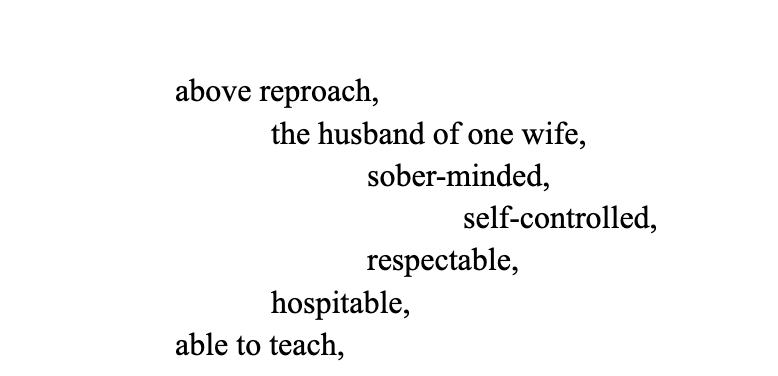
The qualifications that such a man be “above reproach” corresponds to “able to teach” and together they form non-negotiable standards. “Husband of one wife” likely means faithfulness in marriage; it ties to hospitality and a household ordered by the gospel. “Sober-minded” and “self-controlled” indicate level-headedness (not a drunkard), which in turn leads to being respectable and hospitable. These strengths of character are not special or elite requirements but reflect the expectations for all Christians found elsewhere in the New Testament.
Negative Qualities (v.3) — What Elders Must Not Be
Verse 3 articulates what elders must not be: not a drunkard, not violent, not quarrelsome, not a lover of money. Here again, these qualifications comprise a chiasm:
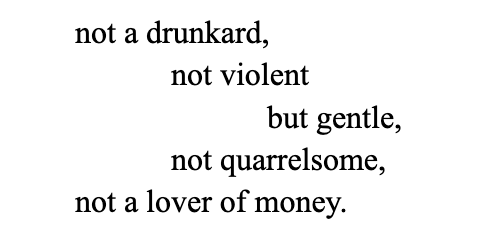
Paul seems to link drunkenness and love of money to idolatry — seeking satisfaction in something other than God. “Not violent” and “not quarrelsome” pair with the call to gentleness. The Greek term for “gentle” conveys not insisting on every right of the letter; it denotes yielding, kind, courteous, and tolerant behavior. Proverbs 19:11 and 20:3 correspond with this gentleness: good sense makes one slow to anger; it is an honor to keep aloof from strife. Paul’s gentleness opposes legalistic, overbearing insistence on correctness.
Household Leadership (v.4–5) — Practical Proof of Capacity
Verse 4: “He must manage his own household well, with all dignity keeping his children submissive.” The Greek term for “manage” carries imagery of standing before the household and ruling it well — the same term appears in 1 Timothy 5:17 about elders who rule well. “Keeping his children submissive” uses military-style language — children under orderly subjection. The rationale is stated in verse 5: if a man cannot manage his own household, how will he care for God’s church? If a man can’t exercise discipline and instruct his own children, he will be unprepared to guide, correct, or discipline the congregation.
Not a Recent Convert (v.6) — Avoiding Pride and Condemnation
Verse 6 warns against appointing a recent convert: a newly planted believer can become “puffed up with conceit and fall into the condemnation of the devil.” An immature believer is susceptible to pride, which can upset both church life and one’s spiritual footing. The Greek construction can be read as a caution — “lest he become puffed up” — highlighting the risk of overconfidence in new converts.
Reputation Among Outsiders (v.7) — Guarding Against Disgrace
Verse 7: “Moreover, he must be well thought of by outsiders, so that he may not fall into disgrace, into a snare of the devil.” The devil aims to ensnare pastors via disgrace. A good reputation among outsiders does not imply sinless perfection but shows a readiness to repent, apologize, and make things right when one errs. This external reputation functions as a protective boundary for ministry.
Conclusion: Above Reproach Inside, Not Disgraced Outside
We can summarize the qualifications for pastors with the following chiastic précis:
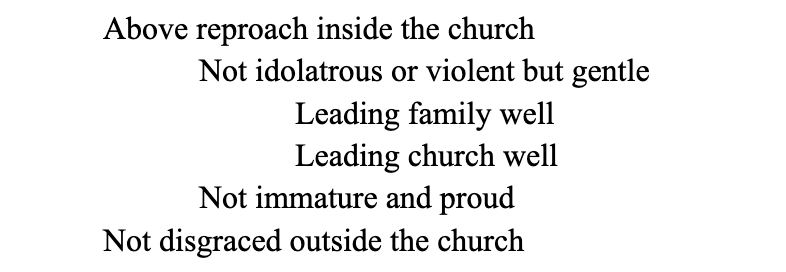
An elder must be above reproach inside the church and not disgraced outside. He must not be idolatrous or violent; he must be gentle; he must lead his family well; he must not be immature or proud.
Christianity is fundamentally imitative: believers look to examples. Jesus taught that those who would follow Him must take up their cross; Paul calls for imitation — “Imitate me as I imitate Christ” (1 Cor 11:1). Paul presents himself as a prototype (1 Tim 1:16): a man once an enemy who received mercy to display Christ’s patience as an example. He calls Timothy to be an exemplar: “Let no one despise you for your youth, but set the believers an example” (4:12); and Peter says elders are to be “types” or prototypes for the flock (1 Pet 5:3).
Paul teaches in 1 Timothy 3:1–7 that churches must have qualified elders who proclaim the true gospel and serve as examples, men whom the members of the congregation can imitate.
[1] This essay is an edited transcript of a sermon by James M. Hamilton at Kenwood Baptist Church in Louisville, KY on January 15, 2026.

Share This Article
-

The Qualifications for Elders (1 Timothy 3:1–7) | From the Pastor’s Desk
By Jim Hamilton
-

Book Review: The Recovery of Family Life: Exposing the Limits of Modern Ideologies
By Trent Hunter
-

Book Review: The Redeemed Man
By Drew Hunter