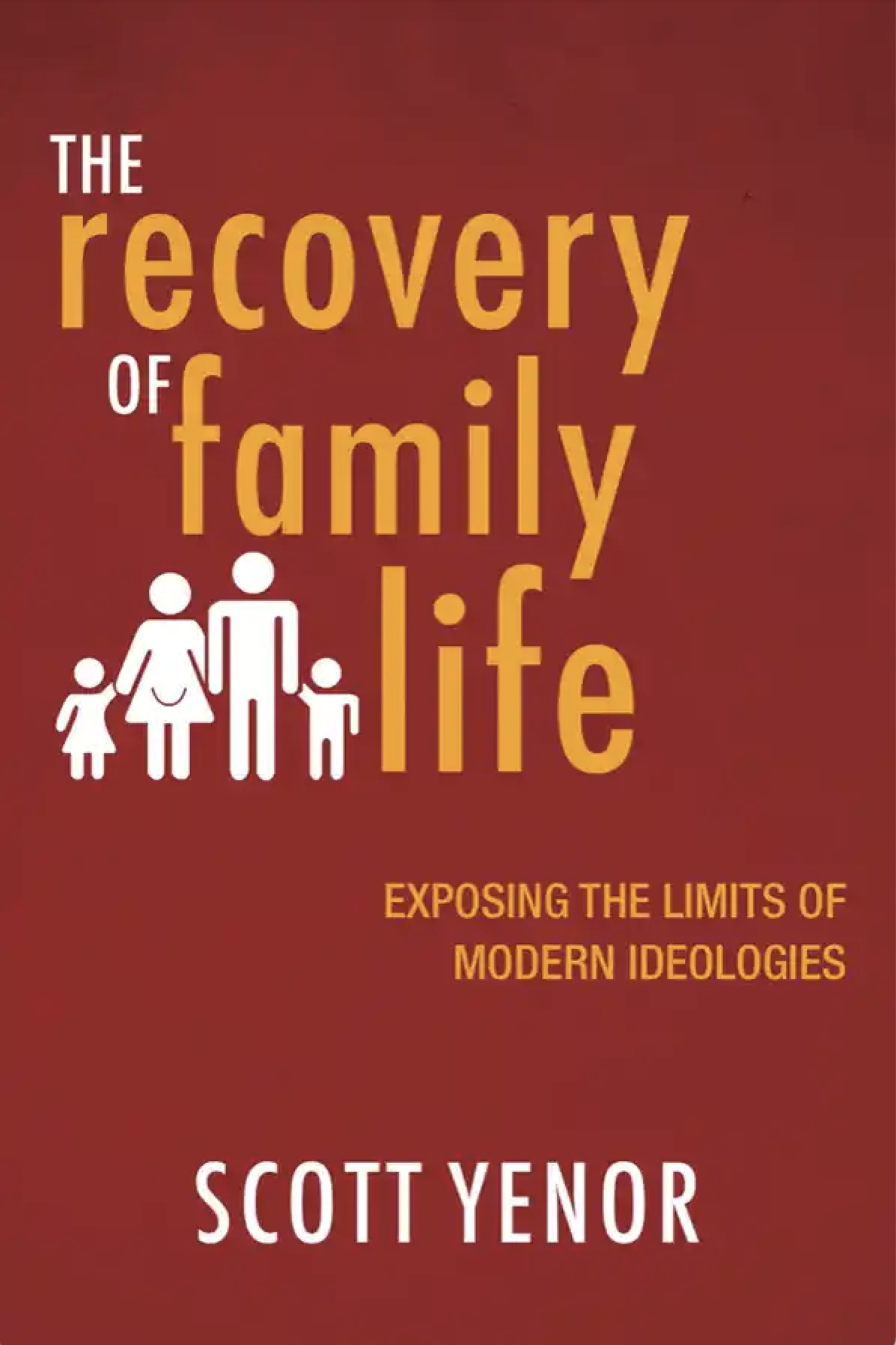
Book Review: The Recovery of Family Life: Exposing the Limits of Modern Ideologies
By: Trent Hunter

Scott Yenor. The Recovery of Family Life: Exposing the Limits of Modern Ideologies. Waco, TX: Baylor University Press, 2020.
I bought a lamp on Craigslist from a lady unpacking boxes. She was single, middle-aged, and new to town for a job. She found out I was a pastor and raised a hostile question about what Christians believe concerning marriage and gender. I answered. I did not expect her to cry but that’s what she did.
In her own words, she had “never heard something so beautiful.” Behind her confrontational question, she admitted, lurked a deep dissatisfaction and sense of loss. She had to explain her tears, after all. They surprised her too. Her family, schooling, and the field in which she worked defrauded her. Again, her words. My plain outline of the Christian vision resonated with her deepest desires. Here was a woman with an apparently designer life — single, successful, in control — alone in a new apartment and sad. It’s a common story and Christians care.
It’s Good to Say Feminism Is Bad
Feminism has not been good to women and I’m done hedging on it. Pornography, children without fathers, hook-up culture, plummeting birthrates, and transgender mutilation are among its fruits. Also among its fruits is a young lady in my community with a dog trained to attack the jugular on command. She’s had bad experiences with men.
I used to say that feminism started good but went bad. But that was not a studied comment. It was a comment crafted to avoid identifying with a particular vision of the past whilst critiquing our culture’s obvious departure from Christian norms. But there is more to the story and more to say.
Scott Yenor’s book, The Recovery of Family Life: Exposing the Limits of Modern Ideologies, is the deeper-dive I’ve needed as a pastor preaching in our times. Yenor’s book is incredibly helpful in documenting the history of the sexual revolution and, crucially, where it is headed (ix, x). He outlines the damage caused and the intractable limits of human nature that frustrate its designs. Since his project largely addresses the breakdown and recovery of the family from the perspective of social sciences, I found myself craving arguments grounded in Scripture and the Christian tradition.
But Yenor deserves a hearing: his vision of family cuts with the grain of Scripture better than the vision on offer in many churches. His is not a book about going back to some dark ages where women were chained to the stove without shoes or forbidden from productivity. It’s a book about how that portrait is neither true to the past nor the honor of homemaking. It’s a book about how treating men and women as interchangeable cogs is not only impossible but undesirable. Who decided homemaking was a byword anyway, and why should we accept that premise (196)? This is a book about leaving our own truly dark age for arrangements that honor our differences as men and women — expressed in age-old grooves for relating with one another that we ignore to our harm.
As for working in the kitchen, Yenor helps make the kitchen great again by highlighting the deep meaning we have in marriage, children, and in sharing a common life as family, at the center of which is the forgotten joy of shared meals (196).
Yenor writes to recover this joy.
Her Weeping is the Sound of “The Rolling Revolution”
A strength of Yenor’s book is its systematic organization. In three parts, The Recovery of Family Life describes three modern ideological streams — feminism, contemporary liberalism, and the movement for sexual liberation — that make up the sexual revolution. He exposes their limits, then points a way forward.
Feminism pursues the abolition of gender and, with it, marriage and family life (ch. 2). First wave feminism (1850–1920) worked to win legal rights for women — property, voting, etc. Sounds harmless enough, but the seeds of hostility to the “enslavement” of matrimony and motherhood were evident (18, cf. 63). These legal changes advanced a premise of women’s oppression under “the patriarchy.” The first wave sought to change marriage, the second wave to abolish the institution.
Starting in the 1950s, movement leaders were not happy with the free choices women were making, so second-wave feminists sought to change the desires of women and subvert their options with laws, “education,” and cultural mores such as easy divorce (28, 55). This is a valuable insight, as it shows the “natural default” of women (evidenced by their free choices) when there was no onslaught of feminist propaganda. Today, all disparity short of 50/50 in a field indicates continuation of the patriarchy and discrimination (27). Except in some fields, such as plumbing or truck-driving, which rarely concern feminists (98). If first-wave feminism divided man and women in the household, in the 1960s and 70s second wave feminism divided procreation from sex. Starting in the nineties, though Yenor does not utilize the label, third-wave feminists separated sex from gender. #MeToo and #BelieveAllWomen are the banners for what can be called fourth-wave feminism. Proponents refuse to identify womanhood with biology. So, here we are.
But feminism is only one of three ideologies that make up the sexual revolution. Meet feminism’s two ugly stepsisters. Contemporary liberalism seeks to reorder the family as a state-centered institution blind to the natural relations of parents and children (ch. 3). Sexual liberationists want a world in which sex is as normal, free, public, and monotonous as eating a granola bar in a park — children included (ch. 4). Traditional morality is a “jailer” from which we need liberation, thus the unhooking of sex from babies and both from marriage (65). They are absolutely serious.
The “rolling revolution,” as he calls it, is the result of these three streams in pursuit of the same goal: the autonomous life (10). For example, feminism advanced a radical individualizing of husband and wife. With gay marriage and transgenderism, the waves keep rolling. Most evangelicals are against gay marriage, but they don’t realize it’s the same principle at play. If men and women are more or less interchangeable, then why not two men or two women? Thus, it’s a rolling revolution because there is no logical end in sight and revolutionaries entertain no principle for its restraint (x).
Except for the pesky limits of human nature, which Yenor explores in Part 2. Real and irrevocable sexual differences limit the ambitions of feminism (ch. 5). Contemporary liberalism may erode the form and quality of marriage but cannot erase the desire of couples to marry and build a family, proof that marriage is pre-political (ch. 6). And for all their trying, sexual liberationists just can’t get us to treat sex like drinking a latte (ch. 7). For example, men and women feel differently after one-night stands. Moreover, not only do rape patterns reflect our differences, but rape degrades our humanity, both male and female, in ways that other acts of violence do not, such as a punch in the face (149). Sex is special. Reality is not “infinitely plastic” (2).
A New Term for an Old Vision
There is much to tear down in the rolling revolution, but Yenor’s work is also constructive. Yenor answers the rolling revolution with what he cleverly calls “womanism” (120). “Language traps us in the feminist view of the world,” so Yenor proposes this new term to capture a vision for womanhood that fits the “bodily and psychological grooves specific to women” (119–120). Yenor aims at traditionally ordered family relationships that honor our different bodies and aspirations. Such a vision promotes the opening of jobs and possibilities for women, for example, but rejects the careerist vision that narrows women’s horizons to work outside the home. Womanism, he writes, promotes independence to a point but not as a defining characteristic of what it means to be a human, man or woman (121).
Yenor’s proposal accounts for more than differences of sex, but what unites us as humans. His proposal is theological:
Above all womanism recognizes the truth that women are not simply victims and men simply oppressors: as Alexander Solzhenitsyn writes, the line dividing good and evil does not run between ideological classes, but through the heart of each man and each woman. Just as the line between good and evil runs through each of our hearts, it runs through each way society tries to rearrange gender and sexual relations. (123)
Yenor’s extensive material on law — consent, rape, divorce, etc. — supports policy makers with arguments and sources for better public policy (chs. 8–12).
One-Stop-Shop for Those Speaking to the Times
Critiquing feminism has become easier as our cultural denial of differences wreaks more havoc. In addition to the social maladies catalogued in this review, we’ve come to appreciate how prioritizing feminine sensibilities is deforming our culture. In 2023, I read that anonymous piece that made its rounds, “What is the Longhouse?” The author’s anonymity speaks to the costs of critique, the article’s popularity supported its thesis. In 2025, I read two pieces, one by Helen Andrews, “The Great Feminization,” and another by Jacob Savage, “The Lost Generation.” These resonated and primed me for Yenor’s book, a masterclass in the history of contradictions that got us to this point.
At Boise State University, where Yenor was professor of political science, he reports some 330 linear feet of books on feminism, all written since 1980. We need faithful guides. Yenor brings us into his well-ordered study. Books and papers cover surfaces, timelines and maps fill the walls. It’s a long and at times long-winded book. His arguments roll on and on, though he did warn (13). But this quirk is a feature just the same. Seventy pages of footnotes and bibliographic material make this a one-stop-shop for primary source analysis that proves the book’s place: in the hands of those trusted to write and speak on these matters.
One of the values of Yenor’s work is all the characters we meet in these descriptions. Simone de Beauvoir’s The Second Sex (1949) influenced Betty Friedan who wrote The Feminine Mystique (1963). Shulamith Firestone imagined a feminist revolution in her book In The Dialectic of Sex: The Case for Feminist Revolution (1970). Judith Butler extended Firestone’s thought in her books Gender Trouble (1990) and Undoing Gender (2004). Butler separated sex from gender and introduced drag and cross-dressing as ways to transgress norms in order to overwrite them. Such contours become familiar terrain.
As we learn, some movement-defining authors hide their cards and others don’t. Beauvoir is among the latter: “no woman should be authorized to stay at home to raise her children,” because “if there is a choice, too many women will make that one. … As long as the family and the myth of the family … are not destroyed … women will still be oppressed” (115). These are the intentions, arguments, and strategies ringing in the ears of professors and politicians, students and TikTok influencers, whether or not they can trace the origin of their sensibilities. Yenor pulls back the curtain on our own dysfunctional, delusional, and demonstrably unhappy times (198).
Another value of The Recovery of Family Life is Yenor’s account of so many connections and contradictions. Contemporary liberals insist on detaching sex from marriage and marriage from children, yet default to natural parents in their dream of state-licensed Care Giving Units (56). Hook-up culture and pornography take the meaning out of sex under the guise of equality for men and women, even goading women to act like men in the name of women’s empowerment (141, 255). A generation of men fail, since the maturity of male strength depends on the sexual resistance of women (238). And for all of the left’s crying out for justice, the devastation of their politics and principles are most acutely felt among the poor, whose horizons shrink with the loss of a strong marriage culture (226).
One of the most profitable features of Yenor’s volume is its catalog of empirically substantiated claims about differences between men and women. From agreeableness to athleticism to aggressiveness to sexual desire, the data shows what we all know: men and women are different (90–108, 185–189). Love minds these limits.
A Solid Landing, Solid Ground, and No Map
Yenor saved his best creativity for the end. He stuck the landing. He delighted with a page-long speech in the mold of William Wallace, so we could hear what it sounds like to herald his proposal with compelling force (242). To close the volume, Yenor addresses popular slogans with pithy paragraph replies (ch. 13). Slogans such as, “Pedophilia is based on the radical notion that children are human beings,” or, “You cannot legislate morality,” or, “Believe all women.” That last chapter was worth the cost of the book.
His landing was solid in that he held my interest to the end and satisfied his own goals. Insofar as he argued from the nature of the world, ontology, and real differences between men and women, he landed on solid ground — the world as it is. But as with any work of sociology, his roadmap for recovery is incomplete. For the pastor, you’re going to want interaction with Scripture and the Christian tradition. You don’t get that here.
Yenor appeals to Old Wisdom (10). He even makes profoundly theological claims (123). Yenor mentions God, Christianity, and religious belief a couple of times in positive ways (120, 169, 172, 210, etc.). The rolling revolution, he writes, “[strips] the Christian or traditional aspects of marriage” (9). But this is about as far as he goes rooting his vision in Christianity. Yenor exposes the limits of modern ideologies with skill. But when it came to charting the way forward — or, properly, backward — he did not drop his anchor in the Christian faith.
This surprised me at first. Yenor is more than a leading pro-family intellectual. He is a public Christian who writes elsewhere on Christian Education and chairs the board of an evangelical Protestant Christian school. But a look at the spine and another read through the preface clarified: Yenor wrote this book for Baylor University Press in part to persuade lukewarm revolutionaries of a better way. This is an academic work for the academy (x). He did not use the term sociology, but the scope of his work bears this out.
Picking Up Where Yenor Leaves Off
Nevertheless, even within that frame, I wish Yenor would have more substantially engaged the Christian shape of the American family. Swiss-born Philip Schaff is one of many — including Alexis de Tocqueville — who have observed the freedom, protection, and honor of American women in the 1800s. In his America: A Sketch of the Political, Social, and Religious Character of the United States of North America (1855), Schaff observed:
The American’s profound respect for the female sex is well known. This old Germanic trait, celebrated so early as by Tacitus, has most fully developed itself in the Anglo-Saxon race under the influence of Christianity, and is very favorable to domestic and public morality. Whoever is acquainted with family life in England, knows how high and dignified a position woman holds there, and how much is comprehended in the term lady. America goes yet a step further. It is sometimes called woman’s paradise.
That is not where we live today. The loss of Christian mores is part of the story. Yenor acknowledges this (9). I wish he would have explored this history further.
Picking up, then, where Yenor leaves off, there will be no true Recovery of Family Life apart from the God who gave us both life and the family. We are fighting false gods in this war of sex, after all, not simply one big unhappy misunderstanding. Neither Greece nor Rome will give it to us. Neither Islam, Hinduism, nor “secularism.” Nor 1950s America for that matter. Christianity gave us Western civilization with its view of sex, marriage, children, and the value of women. Christianity is the only answer to the line of evil that runs through all humanity and all our failed attempts at “liberation.” Christianity alone fits the natural sexual grooves Yenor skillfully describes. In this pastor’s estimation, residual Christian culture is the best explanation for any hearing Yenor’s proposal receives.
The uniqueness of the Christian gospel is my job security. Our world ravaged by the sexual revolution needs Christian preachers and Christian homes. Those Christian homes are not traps for women for the tasks no one wants. The woman described in Proverbs 31 is industrious and intelligent, creative and capable, profitable, skillful, and strong. She works with her hands inside the home and out, all for the good of her household. She blesses them and they praise her. Yet it is her husband who is at the gates (Prov. 31:23, 31). And as Scripture says, she is the weaker vessel, a truth that calls forth male strength, honor not exploitation (1 Pet. 3:7). It’s a truth we deny to the detriment of women. The Christian home is ordered to account for all of this, a place of honor and safety. It’s a better bargain than an email job in a city where nobody knows your name. For, the center of civilization is not the corporate ladder, but the kitchen table; the family, not the individual. Christianity alone elevates women and honors their true strength.
First-wave feminism was not necessary for the achievement of women’s full legal citizenship nor property rights. This could have been pursued without undermining the centrality and structure of the human family. To complement Yenor’s fine book, read Rebekah Merkle’s Eve in Exile: And the Restoration of Femininity.
Yenor holds exactly zero popular views. In his own words, “nothing will be easier to criticize than this book” (x). Yenor has my respect. He should have your attention.
Say It Without Wincing
Why emphasize feminism in this review of a book whose themes are broader? The movement for sexual liberation is something Christians rightly and loudly decry. But we are mostly quiet on feminism. A trick with a term disarms its enemies by playing off our understandable desire to avoid misunderstanding or sounding mean. Thus, feminism is a uniquely pressing manifestation of the rolling revolution, the ideology whose plausibility adds force to the whole.
Here’s the bottom line: Yenor gave this pastor studied confidence to say that to honor women we must oppose feminism — and to do so without wincing under the feminine gaze. By failing to recognize the limits of our sexed human nature, feminism and its ugly stepsisters attempt to reorganize the world in service of a vision of perfect sameness. This is both impossible and undesirable.
As we work to recover the family, let’s tell women unpacking boxes about our good limitations and the good news of liberation. Jesus is the One who makes us truly human, male and female. He alone replaces hostility with harmony, yes even between the sexes. May our churches and homes prove it true. And let’s treat them like ladies, even showing compassion for their plight. I’m with Yenor: “New Girls and single middle-aged women can be forgiven for thinking that they have been sold a false bill of goods” (237).