


Book Review: “Gender as Love: A Theological Account of Human Identity, Embodied Desire, and Our Social Worlds”
By: Michael Carlino
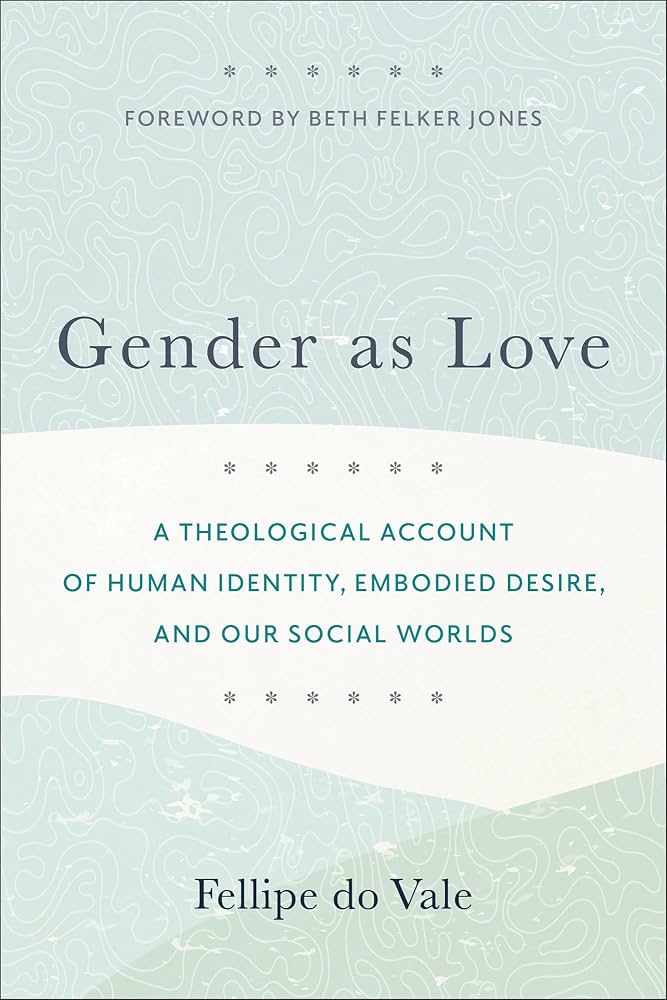
Fellipe do Vale. Gender as Love: A Theological Account of Human Identity, Embodied Desire, and Our Social Worlds. Grand Rapids, MI: Baker Academic, 2023.
Fellipe do Vale provides a theological account of gender in his book Gender as Love: A Theological Account of Human Identity, Embodied Desire, and Our Social Worlds. He seeks to develop a framework that moves beyond the common binary opposition between gender as purely social construct (which he critiques for leading to incoherence or moral relativism because gender becomes arbitrary and unevaluatable) and gender as strict biological essentialism (which he critiques for undervaluing cultural variation). He grounds his account in Christian theology, particularly drawing on Augustine’s theology of love as definitional for gender.
Summary
do Vale defends four main theses:
- Gender is an essence, though this is not reducible to or identical with biological determinism or biological essentialism.
- The complexity of gender, the noetic effects of sin, and the current conditions of oppression complicate our epistemic access to gender’s essence. All the same, we can be assured that issues surrounding gender will be rectified in the eschaton.
- Any theory or theology of gender must be consistent with and supportive of the cultivation of justice.
- Gender is concerned with selves or identity and with the way selves organize social goods pertaining to their sexed bodies (23).
do Vale’s key constructive claim is that gender is love — more precisely, gender involves the formation of personal identity through our loves, specifically our love for certain social goods that are appropriated and manifested according to our sexed bodies. Drawing on Augustine, do Vale views human identity as a “bundle of loves.” What this means is that what we love shapes who we are. Loves are directed toward goods (including social goods like roles, norms, relationships, and cultural expressions). He contends gender “emerges” when these loves organize social goods in ways tied to male or female embodiment. Social goods become “gendered” through being loved and pursued as sexed beings (e.g., manifesting one’s body socially in ways recognized as masculine or feminine). This in his mind bridges sex (biological reality) and gender (social/cultural meaning and identity) without collapsing one into the other. Gender is thus embodied (rooted in sexed bodies), desired (involving affective orientation and longing), and social (pertaining to shared goods in communities).
The account is framed within the biblical metanarrative: creation (goodness of sex/gender), fall (distortion, including gender-based oppression and dysphoria), redemption (Christ-centered reorientation of loves), and consummation (eschatological renewal and justice). Normatively, the focus is on cultivating virtue and rightly ordered love(s) (ultimately directed toward God) rather than prescribing rigid trait lists for “masculine” or “feminine.” This allegedly allows for a more compassionate and dignifying experience in society for those suffering under gender dysphoria or intersex conditions while affirming the goodness of male and female distinctions.
Critical Evaluation
There are three significant points of criticism I will focus on for this review, and that is how do Vale: (1) cites exceptions and distortions wrought by sin to undermine the knowability of creational goods; then (2) turns questions of gender roles into social justice (ethics) debates devoid of natural law (ontology); and finally (3) signals his model can be “accomodated” for so-called “trans ontologies.”
In evangelical circles, a recurring theological error has emerged in which the familiar schema of creation, fall, redemption, and consummation is misapplied to undermine the goodness and intelligibility of creational norms. In do Vale’s work, eschatology is pressed into service to effectively abrogate or relativize these created goods. What Scripture presents as natural features or fitting applications of the created order (e.g. male headship in marriage; male-only clergy, etc.) are instead recast as distortions introduced by the fall, and therefore as constructions that can (and should) purportedly be left behind. This approach, however, rests on a fundamental misunderstanding of the relationship between nature and grace. As the Christian tradition has long affirmed, grace does not destroy nature; it restores and perfects it. The redemptive work of Christ and the hope of consummation do not nullify the structures, norms, and goods embedded in creation. Rather, they restore what sin has marred and bring those goods to their intended fullness and glory. do Vale gives assent to such sentiments while simultaneously subverting them with his theological methodology and application.
My primary frustration after reading the book is that it proves consistently (and even intentionally) impractical as a guide for Christian living. It repeatedly appeals to exceptions, pathologies, or post-fall distortions in order to cast doubt upon the clear norms and patterns that Scripture reveals within the created order itself. By treating the abnormal or the broken as normative for theological reflection, or by citing disorders such as intersex as reason to “withhold epistemic surety” (203), the argument subtly erodes confidence in the goodness and reliability of God’s original design. In the end, exceptions do not prove the rule, but rather, for do Vale, exceptions remove epistemological assurance that there are metaphysical norms which can be known.
In short, when one cuts through the weeds of what it means that humans are “love bundles” we find yet another effort from a modern evangelical to reduce gender to little more than biology. do Vale explains that according to his model, the “kind essence ‘man’ requires nothing other than a male body and the identity-forming love of particular social goods, and the kind essence ‘woman’ requires nothing other than a female body doing the same” (170). In so doing he seeks to transpose the conversation from ontology into ethics “where concrete individuals actually live” (170). Such a move, we are led to believe, is “Augustinian,” even Christian.
But what happens when we move away from ontology into ethics for the sake of gender justice? Unsurprisingly, for do Vale it at least opens the door for female ordination:
Debates about the ordination of women are, in many ways, debates about whether ordination is a gendered good, a good to be loved and appropriated only by those with particular bodies. Is ordination a gendered good to be loved in virtue of one’s sex, or should it be seen as a good to be loved independent of sex? For some, including myself, it is unjust to preclude in a categorical way all those with female bodies from loving this good and occupying the social role it creates (166, emphasis mine).
Notice how do Vale moves the debate about female ordination from one of ontology into a question of ethics, before pronouncing it is therefore unjust to preclude an individual with a female body and identity-forming love from this “social good.” Here and elsewhere, do Vale repeatedly plays the trump card of value and worth to dismiss the specter of hierarchy and oppression. The reader is left to assume a direct correlation — if not outright causation — between the two. This critique draws its force from the prevailing egalitarian spirit of our age. However, those who affirm a robust ontology (that the distinctions between men and women run deeper than mere embodiment and/or self-perceived identity) will assuredly remain unimpressed.
In fact, at one point do Vale critiques an essay published in a previous Eikon which he summarizes as favoring a “natural law approach to gender and claims that Adam’s creation temporally prior to Eve must mean that masculinity is identical to authority” (181). But is this not precisely what the Apostle Paul teaches in 1 Timothy 2:11–13? As Kyle Claunch and I have argued on these verses:
Adam’s appointment to this role [as federal head of all humanity — including Eve — and Eve’s head in marriage] is not a result of his order of creation, rather his order of creation reveals his appointment. Furthermore, this appointment was not arbitrary, such that God could have interchangeably created Eve first and appointed her the head. As natural complementarians, we readily affirm male headship (covenantally defined) in the church and home, and male leadership (naturally fitting) as the norm in broader society are not merely a product of Bible verses, as though Scripture speaks such concepts into existence ex nihilo. Rather, the Bible ratifies God’s design and thus reality. Put differently, we maintain that covenantal headship in the church and home is built upon God’s created order, and therefore the principle of male leadership cannot be confined only to these domains, as though it has no bearing on the broader society.[1]
do Vale is not wrong to suggest that a traditional natural law approach to anthropology concludes masculinity is inherently authoritative and femininity is inherently submissive. He is wrong to disparage such conclusions. Rather than ask “has God surely said?,” his workaround frames it as, “why would God unjustly discriminate against those with female bodies?” Once ontology is critiqued and removed, the ethical deliberation pertaining to whether a woman is qualified for pastoral ministry is centered around “those with female bodies,” such that ontology is reduced to and/or even replaced by biology and identity formation. I contend that this line of thought undermines God’s good design for male and female distinction, which goes far deeper than the thin account for essence offered by do Vale.[2]
Lastly, do Vale candidly reveals in a footnote that his model is “not necessarily a trans* exclusive ontology,” because the “only modification required would be to organize around “the perception of a male body, and mutatis mutandis for female bodies. The actual possession of a female body is not needed to be perceived as having one” (170n70). This is truly an astounding claim. To be clear, do Vale is not advocating for a so-called “trans ontology,” as his self-admitted “attenuated form of gender essentialism” seeks to “avoid both gender skepticism and biological essentialism…Crucially, this essentialism is useful for virtually nothing other than the prevention of gender skepticism” (170). But allow me to amplify the self-defeating irony: do Vale’s “gender” essentialism is useful for nothing other than not being skeptical of gender — a low bar indeed — but he himself then notes his system can be accommodated by/for those who deny even his most minimalist claims.
It is precisely at this point that the “theological” framework offered by do Vale reveals itself to be so minimalist as to be useless for and antagonistic to Christian witness. To put the matter bluntly: any anthropological model that can be comfortably accommodated within a so-called “trans ontology” — a phrase that is itself an oxymoron — is inherently unfit for faithful Christian service. Recent legal developments only underscore the urgency of this critique. In the landmark case of Fox Varian, a detransitioner was awarded $2 million in damages against Dr. Simon Chin for failing to obtain truly informed consent before performing irreversible surgical procedures. Cases like this signal that the ideological edifice of transgenderism is beginning to crumble under the weight of its own medical, psychological, and ethical malpractice. History will not judge kindly those who, in the name of theological sophistication, offered a thin and attenuated account of human identity and embodied desire open to such morally repugnant ideologies.
The sophistry of thinkers like do Vale lies in proposing a vision of theological anthropology so stripped of its biblical substance that transgenderism is not repudiated as a profound distortion of the imago Dei, but is instead quietly invited to find accommodation within this professed “Christian” framework. What is presented as nuanced engagement is, in reality, a capitulation that exchanges the clear teaching of Scripture on creation, fall, and redemption for a vague essentialism in which the givenness of the body is treated as negotiable. It is sad enough a professing Christian scholar thinks this way anthropologically, it is worse yet that such thoughts were put to paper and printed by a major Christian publisher.
[1] Kyle Claunch and Michael Carlino, “Gender Essentialism in Anthropological, Covenantal, and Christological Perspective,” Eikon 6, no. 2 (Fall 2024): 38.
[2] For more on the depths of the distinctions between men and women, see Herman Bavinck, The Christian Family (Grand Rapids, MI: The Christian’s Library Press, 2012), 67–69.