

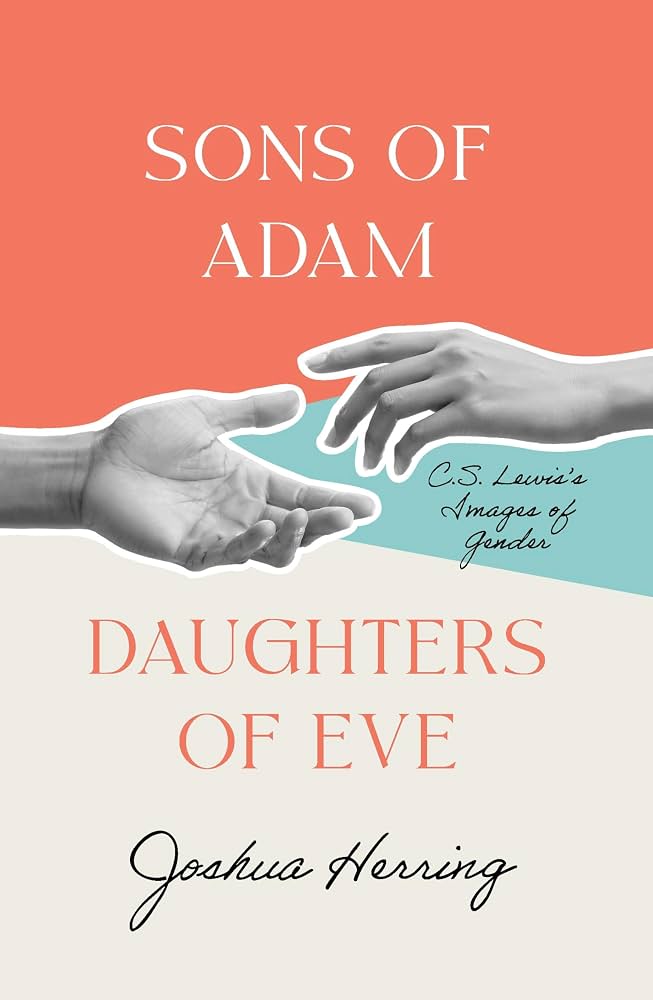
Book Review: Sons of Adam, Daughters of Eve: C. S. Lewis’s Images of Gender
By: Louis Markos
Joshua Herring. Sons of Adam, Daughters of Eve: C. S. Lewis’s Images of Gender. Landrum, SC. The Davenant Press, 2026.
Although there is a legitimate place in the church for hellfire and brimstone sermons, there should be more sermons that draw people to the love and mercy of God displayed in the life, death, and resurrection of Christ and less that, literally, scare the hell out of them. That does not mean that sin should be downplayed or the holiness of God papered over; Jesus does not shy away from exposing the sins of hypocritical religious leaders and warning them of God’s wrath to come (Matthew 23).
Still, Jesus more often calls individuals like Nicodemus and the Samaritan woman at the well (John 3–4) and groups like those at his Sermon on the Mount (Matthew 5–7) out of their brokenness, confusion, and sorrow to a higher vision of integrity and wholeness. In my own mentoring of students who struggle with gender identity, I have learned to focus on affirming their God-given masculinity or femininity in a manner that goes far deeper than the stereotypical interests and relational approaches that our society dictates for men and women.
Instead of simply condemning the sin of transgenderism or homosexuality, how much better to promote the beauty, goodness, and truth of God’s creation of gender — “So God created man in his own image, / in the image of God he created him; / male and female he created them” (Genesis 1:27; ESV) — and of marriage — “Therefore a man shall leave his father and his mother and hold fast to his wife, and they shall become one flesh” (Genesis 2:24). Or, to express it in the words of a well-known hymn, “Turn your eyes upon Jesus, / Look full in His wonderful face, / And the things of earth will grow strangely dim, / In the light of His glory and grace.”
If we are serious about reaching our society with the good news of Jesus, our message needs less condemnation and more vision; it needs to invite those who struggle with their gender and sexuality to embrace with understanding and gratitude God’s gift of gender and heterosexual marriage. That, I am happy to say, is the approach that Joshua Herring takes in Sons of Adam, Daughters of Eve: C. S. Lewis’s Images of Gender. Through close and parallel readings of Lewis’s Ransom Trilogy, Chronicles of Narnia, and selected non-fictional works, Herring demonstrates that for Lewis, “all of reality is God’s gift to his image-bearers” and that “we ought to receive the gift and express gratitude through our joy in its goodness. . . . Lewis suggests that Christians should, for the good of the gender-dysphoric person, invite all people to accept their gender and learn to love the God who made each one male or female in his image” (258).
Herring, professor of humanities and classical education at Thales College and founder of the Logres Institute for Classical Liberal Studies, takes this positive approach, mining from Lewis’s work images of gender that celebrate God-given masculinity and femininity. However, like Socrates and Plato before him, Herring knows that he cannot properly define the true nature of gender before first deconstructing the false definitions that have increasingly come to dominate the last half century. He does so by accurately summarizing and fairly criticizing the work of Simone de Beauvoir and Judith Butler.
The Making of Feminism’s Myths
The reason de Beauvoir and Butler have caused so much confusion, Herring argues, is that their redefining of gender was couched in a re-mythologizing of identity itself. “De Beauvoir,” he explains, “famously claims that ‘one is not born, but rather becomes a woman.’ . . . women are formed through social pressures and traditional institutions into the Other needed for male conquering and identity formation” (19-20). Femininity is not something that one is born with or that one possesses as an essential feature of one’s created nature, but a social construct imposed upon the growing girl. “Rather than revolting against the formative society, the girl is shaped into one who resigns her autonomy and accepts her status as object of the male subject” (22).
Just as the worker in Marx’s re-mythologizing of economics is alienated from the objects of his labor, so the woman, in de Beauvoir’s re-mythologizing of gender and the relationship between the sexes, is alienated from her self. Ironically, despite her Marxist worldview, de Beauvoir holds up the workplace as the only arena where a woman can find true autonomy and self-identity. “De Beauvoir posits that woman is imprisoned by marriage and reproduction; her freedom lies in becoming an active economic agent through work, which establishes personhood” (25).
After summarizing de Beauvoir’s thought, backing up his summary with representative excerpts from her influential book, The Second Sex, Herring offers his critique. “In essence, de Beauvoir wants women to become men; when they engage in masculine activities, they gain an equal subject-status alongside men. The new world she imagines is one without gender: men and women exist equally as subject, free to follow their desires without care for responsibilities. Her theory has no room for willing acceptance of responsibilities; any woman who would willingly become a mother, undergoing the mutilation of her body through the alienation of childbirth, has not yet overthrown the remaining object-status binding her to the male subject” (29).
The Second Sex was published in 1949, at the dawn of what many Americans consider the golden age of the traditional family. It took two decades for her myth to take root, fueling the sexual revolution, no-fault divorce, abortion-on-demand, and the mass exodus of women out of the home and into the workforce. The full breakdown of gender, however, awaited Butler’s post-modern Gender Trouble (1990), which reduced not only gender but sex itself to a fluid designation free from any kind of fixed, essential nature. “Neither gender nor sex, Butler argues, is natural, but rather are constructions of socially expressed power. Disrupting that power becomes the avenue to freedom and authentic self-development” (36).
Paving the way for transgenderism’s invasion of the public square, the academy-bound Butler insisted that “the task for an authentic human being is to use the autonomous will to shape the plastic self by rejecting reality as it presents itself in favor of the self-constructed reality” (37). For Butler, nothing is given: neither given in the sense of a gift from our creator, nor given in the sense of a founding principle that grounds reality. Everything is in flux: natural or unnatural, right or wrong, normal or perverse, straight or crooked have no meaning because there is no fixed standard against which to measure them.
De Beauvoir and Butler’s “philosophical mythmaking,” Herring concludes, “advocates a rejection of the gift of gender in favor of radical autonomy” (41). How is one to answer this seismic shift in perception and imagination? “The way to refute such a myth,” Herring argues, “is not through a consequentialist analysis of its results, but rather through a more true myth which begins from different presuppositions. For that analysis, C. S. Lewis proves an excellent guide. Where de Beauvoir and Butler see gender as a site of critique and oppression, Lewis proposes that it is instead a part of human nature, and an invitation to accept that which is given, explore the totality of the gift, and wonder at the ways complementary gifts between men and women enable flourishing lives together. The way to respond to bad philosophy, Lewis shows, is with good stories” (42).
God’s Gender Myth in C.S. Lewis’ Ransom Trilogy
After an insightful chapter on how Lewis’s views on gender were influenced by Spenser’s Fairie Queene and Milton’s Paradise Lost, Herring sets about identifying in Lewis’s work images that can help our shattered, topsy-turvy world restore God’s original myth of gender. For Lewis, Herring argues, gender, like math and the Tao —the word Lewis uses in The Abolition of Man to refer to the universal, cross-cultural moral/ethical code — is a key component of the objective (real) world created by God. It is a given, a first thing, something we argue from rather than for. Indeed, gender “is one of those places where humans experience the contact between the immanent, sensual reality and a higher intellectual level of reality” (102).
In his Ransom Trilogy, Lewis renders concrete the essential nature of masculinity and femininity in the contrasting geographies of the planets Mars (Malacandra) and Venus (Perelandra), in the complementary guardian spirits of those planets, and in the equally complementary King and Queen that God (Maleldil) creates on Venus. In all three, masculinity and femininity as essences run deeper than biology, function, or language. “The masculine is primarily oriented outwards, with a rigid strength and watching eyes seeking to defend the home; the feminine is primarily oriented inwards, and is characterized by fluidity and fostering life, symbolized through the creation of a home” (122).
In his analysis of the characters that populate the Ransom Trilogy, Herring shows that men and women alike are strengthened by acquiring some of the traits connected to the opposite gender while embracing and embodying the essential gender they were given. This process includes a vital factor that runs counter to the prevailing post-modern myth of fluidity and autonomous individuality: obedience to proper authority, along with the humility that accompanies it.
In Ransom, who leads the good guys in That Hideous Strength, Herring finds a rich embodiment of biblical masculinity. “Ransom carries with him a gravitas commanding immediate respect. All who come into his presence recognize the authority he wields and must respond” (132). That response helps them to understand and to grow into their true selves. In sharp contrast, Wither, the leader of the bad guys, demeans and confuses all those who serve under him. Through Ransom and Wither, Lewis presents his readers with “two visions of authority, one based in clarity and one in obfuscation, one making more of its followers and one making less” (134).
In two of the women who serve under Ransom (Grace Ironwood) and Wither (Fairy Hardcastle), Herring identifies contrasting examples of women who assume masculine traits of authority but in radically different ways. “Ironwood illustrates the ways such a woman contributes strength to her community without losing her essential womanliness, while Hardcastle’s brutish habits and sardonic tone and cheroots make her distasteful . . . Ironwood has a strength of character forged through her experiences that, yielded to right authority, adds to the value of the community. Hardcastle shows the extreme power and rigidity possible to a strong woman who refuses to yield to anyone else” (134).
God’s Gender Myth in C.S. Lewis’ Narniad
In Lewis’s Narniad, Herring finds equally contrasting images of masculinity that do or do not go “outward, leading and/or protecting” and femininity that do or do not go “inward, creating the conditions for life to flourish” (142). Thus, as illustrations of positive masculinity, Peter rescues his sisters in The Lion, the Witch and the Wardrobe (LWW); Cornelius “provides Caspian the formal education needed to help him move from childhood to manhood” (148) and Caspian and Peter embody “the necessity of the masculine to identify and oppose evil in the world” (151) in Prince Caspian (PC); Reepicheep and Caspian inspire courage in Eustace and the crew in The Voyage of the Dawn Treader (VDT); the freed Rilian shows forth his kingly authority in his looks and bearing at the end of The Silver Chair (SC); and the martial Tirian and Jewel offer “the clearest example of masculine friendship in the Narniad” (166) in The Last Battle (LB).
In contrast, we see negative masculinity in Edmund’s betrayal of his siblings in LWW; in Miraz the usurper who kills his brother and Nikabrik the dwarf who “seeks power without concern for the good” (190) in PC; in Governor Gumpas who, like Wither, is “a bureaucrat who excels at preventing action from occurring” (193) in VDT; in Rilian who “illustrates a masculinity ensnared by [the] toxic femininity” (195) of the Green Witch in SC; and in Rabadash’s pride that “causes him to ignore the rules of war” (198) in The Horse and His Boy (HHB).
Positive femininity is glimpsed in “the feminine concern for the conditions of life [that] prompts [Mrs. Beaver’s] awareness that even on an urgent journey, the group will need food” (169) in LWW; in Susan and Lucy accompanying Aslan “the source of joy in renewing Narnia” (174) while the boys fight in PC; in Lucy exercising “courage in a feminine manner” (176) by going into Coriakin’s house to save lives rather than to win personal renown in VDT; and in the way “Polly’s caution tempers Digory’s adventurousness” (186) in The Magician’s Nephew (MN).
Negative femininity, in contrast, is glimpsed in the White Witch, who “is not a source of warmth, fluidity, or life, but rather cold rigidity and death” (201) in LWW; in the Green Witch who “trades on her femininity to deceive the children” (204) in SC; in Aravis’s initial pride which “manifests in a lack of compassion for a servant she uses to cover her escape” (205) in HHB; in the “affinity for power and death” (206) that Jadius manifests in MN; and in Susan’s refusal to embrace with gratitude the life-giving gifts of Narnia and Aslan in LB.
Herring identifies more images of gender in Lewis’s writings that possess the power to restore the true myth of gender our society has lost, but these should suffice. “Christians,” he concludes, “require positive language to proclaim the goodness of gender as they combat gender ideology. Lewis equips his readers to reach that goal” (257). The sooner we equip the next generation with such images, the sooner they will be able to reassemble the shattered icons of masculinity and femininity they have inherited from the false myths of de Beauvoir, Butler, and their heirs.