
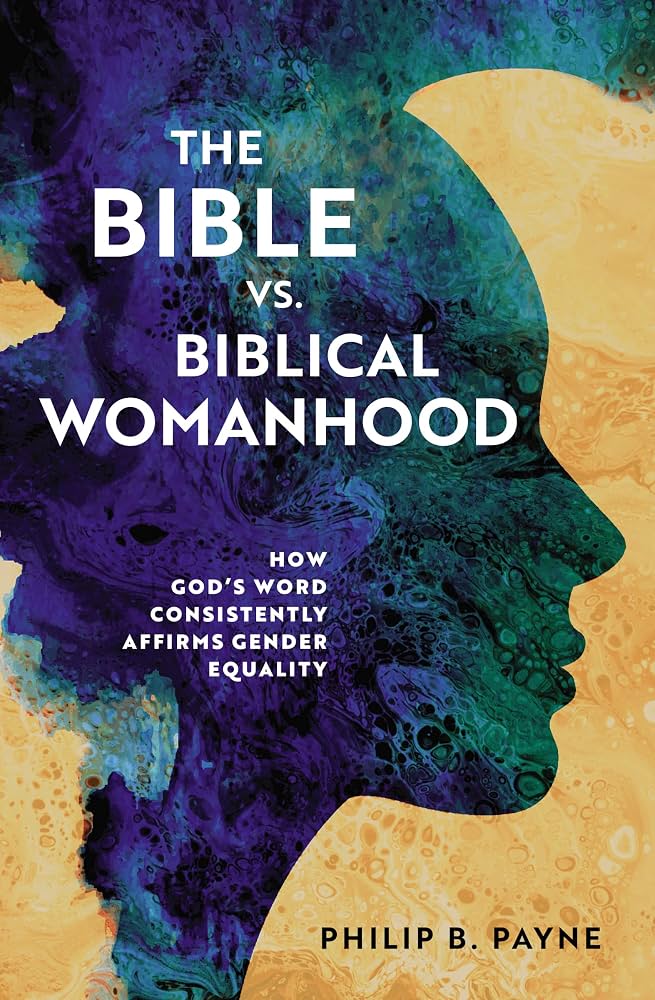
Book Review: “The Bible vs. Biblical Womanhood: How God’s Word Consistently Affirms Gender Equality”
Philip B. Payne The Bible vs. Biblical Womanhood: How God’s Word Consistently Affirms Gender Equality. Grand Rapids: Zondervan, 2023.
Introduction
The Bible vs. Biblical Womanhood represents Philip Payne’s most recent attempt to affirm the biblical basis for men and women as equal in the home, church, and society. The book summarizes and extends his prior work on the subject, particularly his 2009 work Man and Woman, One in Christ. As indicated by the title, Payne rejects the notion of “biblical womanhood,” which he describes as “male headship” and “female subordination.” The book’s thesis is that “God desires men and women to serve and lead alongside each other within the church and family, as equals, in whatever ways they are gifted” (182).
Summary
Not counting the front and back matter, the book comes in at just under 200 pages, which means it moves quickly through the relevant biblical texts and arguments. Those familiar with the standard egalitarian vs. complementarian debates will find some of the ground well-trodden. For instance, Payne argues that:
- Genesis 1 gives man and woman equal responsibility for exercising dominion, and nothing in Genesis 2 overturns this.
- Male headship is a product of the fall.
- Deborah’s story shows God is pleased when women lead God’s people.
- Female prophets in the Bible prove the goodness of female leadership, for prophecy is a form of preaching and teaching.
- The excellent wife of Proverbs 31 leads her household, which suggests women are leaders in the home.
- Jesus encouraged women to be his disciples, and women like the Samaritan woman and Mary Magdalene had crucial ministries of teaching.
- Jesus chose male apostles only to avoid scandal and to show the church as the new Israel.
- The named women in Romans 16 are ministry leaders, especially Phoebe, Prisca, and Junia.
- The term kephalē means “source,” not “authority” or “preeminence.”
- Galatians 3:28 means that women must not be excluded from potential church leadership.
- A wife’s submission to her husband in Ephesians 5:22–24 is relativized by the requirement for mutual submission in Ephesians 5:21.
- First Timothy 2:11–12 merely prohibits deceived women from teaching at Ephesus, not women from teaching in general.
In addition to these common arguments, Payne advances newer arguments from Titus 2 and 1 Peter 3. He suggests that Titus 2:1–8 doesn’t differentiate believers but elders — older male elders, older female elders, and younger male elders. In 1 Peter 3:7, the word “likewise” means that husbands should submit to their wives just like wives should submit to their husbands.
Appreciation
While I remain unconvinced of Payne’s overall thesis, I appreciate his commitment to biblical inerrancy, as stated at the outset of the book. While complementarians and egalitarians may debate what the biblical text means, it must always be the biblical text that is debated. We must go back to the biblical text and stand under its authority.
Also, Payne communicates clearly throughout the book, and his arguments are easy to follow. For example, he defines his terms at the outset, which include key concepts like hierarchy, complementarity, and equality (xxi–xxvi). While I disagree with his definition of equality — he defines it as “equal access to power” — his arguments were easier to understand because he clearly articulated his definitions.
I also appreciate how in each chapter Payne briefly analyzes the biblical data and then addresses common objections. Occasionally I would write an objection in the margin of his analysis, only to find that he addressed my objection later in the chapter. Even if I didn’t find his answer compelling, I appreciated the attempt to answer the objection.
Disagreement
Despite the book’s strengths, his thesis fails to convince because he confuses gender hierarchy with equality, Christian leadership with Christian fellowship, and submission with humility.
Payne considers all forms of gender hierarchy to be “favoritism” (xviii), and he defines equality as “equal access to power” (xxii). He denies differentiated, God-given roles to men and women in the home, church, and world, for such is inherently partiality. But gender equality in Scripture doesn’t erase gender diversity, whether in the home, church, or world. Payne rightly emphasizes that men and women are equal, but he minimizes the God-ordained differences between men and women, which actually testify to their complementarity, not their inequality. Payne complains that gender “roles” is a modern notion, but actually the concept derives from a simple recognition that according to the Bible men and women are different.
Similarly, Payne confuses Christian leadership with Christian fellowship. In his analysis of Galatians 3:28, Payne says that the principle of unity in Christ means we should not exclude women from positions of leadership. He supports this by drawing a parallel to the Antioch incident, in which Peter excluded the Gentiles from table fellowship (Gal 2:11–14). If in Christ there is no more Jew or Greek, then Peter’s behavior was no longer in step with the truth of the gospel (Gal 2:14). Payne rightly sees social ramifications as a necessary outflow of the gospel, but he confuses Christian leadership with Christian fellowship. The Antioch incident exhibits how the gospel undergirds Christian fellowship, not how the gospel provides every Christian with “equal access to power.” A better application for Galatians 3:28 today would be that churches must not deny women from being baptized, becoming members of a local church, and partaking of the Lord’s Supper. To exclude women from such Christian fellowship would be antithetical to the gospel and our unity in Christ. But this is distinct from Christian leadership. While Christian fellowship accents the unity of the church, Christian leadership derives from the diversity within the church.
Payne also confuses submission with humility. He says that Ephesians 5:21 “means that each person treats the other as more important than themselves,” and that this passage “undergirds the nature of Christian leadership as humble service” (176). Certainly Christian leadership should be humble, but this doesn’t mean Christian leadership submits. Indeed, every Christian should be humble and look to the interests of others, but this isn’t what submission means. The Greek term for “submission” (hypotassō) inexorably involves hierarchy in which one follows or obeys an authority. Payne’s failure to recognize the distinction between submission and humility keeps him from giving an adequate account of why Paul instructs wives to submit to their husbands and husbands to love their wives (Eph 5:22–33).
Finally, when it comes to the exegesis of the biblical texts, much could be said both for and against Payne’s interpretations. Suffice it to say that the reader should remember the following key hermeneutical principles. First, the context must always determine the meaning of a text — for example, does the narrative arc of Judges really lead us to imitate the story of Deborah? Second, the text to interpret should be based on solid manuscript evidence — for example, is 1 Corinthians 14:34–35 plausibly a scribal addition if every extant manuscript includes it? Third, our conclusions must derive from what the text actually says — for example, if we agree from 1 Corinthians 11:11 “how important it is that women and men are not separate in the Lord” (71), does this suffice to overturn gender roles? In these three areas Payne’s book suffers from unwarranted hermeneutical judgments.
Conclusion
In conclusion, The Bible vs. Biblical Womanhood adds to the growing list of books on the Bible’s perspective on women and leadership. While it offers some helpful insights, Payne’s overall thesis fails to convince. Christians will find firmer hermeneutical ground by making more careful distinctions and by more rigorously attending to the biblical text. For this reason, I cannot recommend this book for pastors or lay Christians. Of course, academic types may want to engage with Payne’s work, though I wonder if his more extensive 2009 volume would contain more substance for scholarly engagement.