


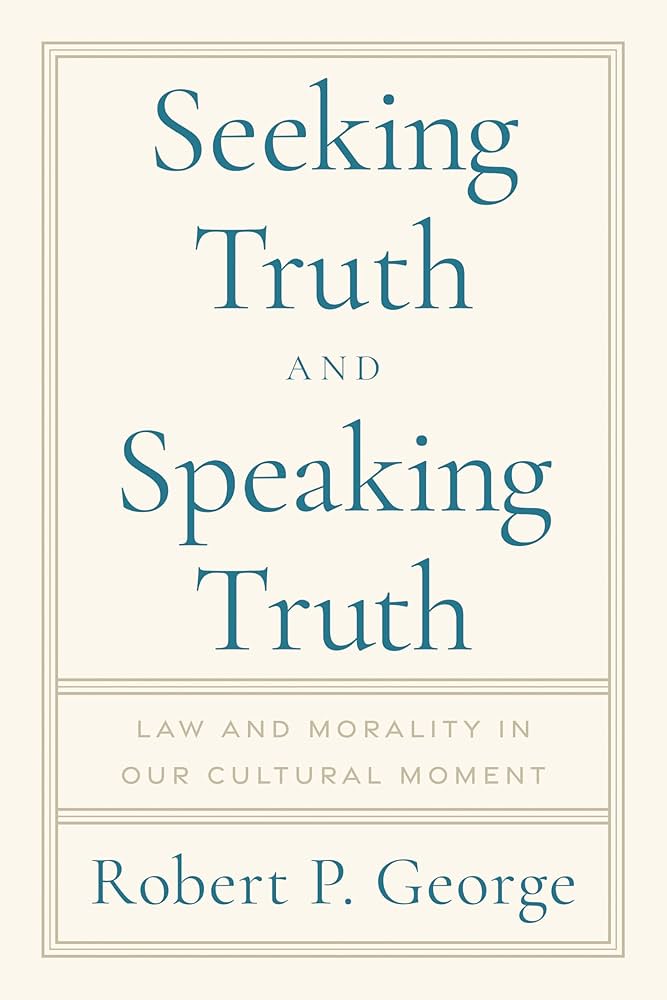
Book Review: “Seeking Truth and Speaking Truth: Law and Morality in Our Cultural Moment”
By: Doug Richey

Robert P. George. Seeking Truth and Speaking Truth: Law and Morality in Our Cultural Moment. New York, NY: Encounter Books, 2025.
Introduction
Gone is the “Age of Faith.” Gone is the “Age of Reason.” Now is the “Age of Feelings.” Individuals are convinced that truth must comport itself with their feelings, feelings that cannot possibly be incorrect (xii). This is where Robert P. George, the McCormick Professor of Jurisprudence and director of the James Madison Program in American Ideals and Institutions at Princeton University, begins his discussion of a wide range of topics in Seeking Truth and Speaking Truth: Law and Morality in Our Cultural Moment. He continues by describing our cultural milieu as, “the spectacle of people embracing a fierce moral absolutism based on beliefs that are the products of nothing more than subjective feelings” (xii). As a pastor, legislator, public theology practitioner, and conservative public policy advocate, I echo Professor George’s description and appreciate his starting point. From Sunday School discussions to legislative floor debates, from social media posts to water-cooler conversations, what is most often revered as authoritative is what is “felt.” Today’s consequential issues, and the debates surrounding them, are assumed to be most often won by skilled emotive tacticians, unless George has his way.
Summary
The proposition put forth in the book’s preface can be substantiated by countless examples. We can observe the public expectation that personal feelings are off-limits during a critique, the emotional manipulation by PR and marketing firms, and the use of heart-wrenching stories by political consultants to sway constituents. Furthermore, the general public often attempts to avoid direct accountability for thoughts on difficult questions through emotional language. The typical approach is to lead with emotional appeals, with thoughtful content — if it is ever presented at all — coming much later. Within this context, how does George address critical questions? He does not pander to this prevailing appetite. Instead, he arms his readers with logically sound, well-articulated, and thought-provoking arguments founded upon natural law.
In his latest work, George guides his readers through challenging terrain in twenty-three chapters, organized into four parts, presenting material from essays, legal briefs, and other writings from George’s lengthy career as a scholar and public intellectual. George navigates issues like equal protection and the unborn, human dignity, marriage, economics, education, and medical ethics, among others. In each, he brings a well-reasoned explanation of natural law’s influence and conclusion. By highlighting the importance of basic human goods (what he identifies as the foundations of natural law) and their necessity to human flourishing, George provides us with discerning analysis and compelling positions.
This resource is not for the casual, undisciplined reader. George requires your attention to the details of his developing arguments. He constructs well-reasoned, well-defended, logical arguments that provide structure for his conclusions. One can see how his legal mind asks questions, exposes problematic assumptions, and provides substantiated rebuttals. In his chapter addressing campus illiberalism, for example, George identifies the “core of the problem” to be “…institutions…subverting the transmission of knowledge by failing to ensure that their students…have the opportunity to consider, the best that is to be said on competing sides of all questions that are in dispute among reasonable people of goodwill” (262). He provides support for this claim (261–262), identifies its scandalous effect (263), describes the challenging nature of getting it “right” (263–265), and then offers needed steps to rectify the problem (266–272). For a more demanding, yet fruitful, example, one will benefit from the sixty-seven page argument addressing equal protection and the unborn (129–196). Reading George’s work demands much, but rewards the attentive reader with muscular responses to today’s most controversial issues.
Beyond offering responses to controversial issues, George’s work provides an additional benefit. I have witnessed, on countless occasions in both ministry and legislative contexts, instances where well-meaning people struggled to articulate, let alone ground, their understanding of fundamental questions. Questions regarding life, virtue, justice, marriage, family, sex, identity, etc., all demand more than half-baked feelings. The pages of George’s book, like so many of his prior works, bring the value of natural law into focus. Natural law, natural rights, and basic human goods, finding their source in God’s creation order, provide structure and animation to our understanding of these critical matters. To the extent that we are ignorant of these concepts, we will struggle to offer sound arguments consistent with the reality in which God has placed us. George works to expose his readers to the animating influence of these concepts.[1]
Critical interaction
There are weaknesses in Seeking Truth and Speaking Truth. First, George stops short of grounding human dignity in the Imago Dei. In his first chapter, addressing fundamental aspects of human dignity, George states, “We argue that all human beings…have equal fundamental dignity” (3). Why? “In truth, all human beings have real dignity simply because they are persons — entities with natural capacities for thought and free choice” (5). George further argues, “…having a rational nature is the ground of full moral worth” (19); and, “…they have a rational nature…In virtue of having such a nature, all human beings are persons; and all persons possess profound, inherent, and equal dignity. Thus, every human being deserves full moral respect” (23). George would do well to take the next step by identifying the ultimate ground for human dignity and value: the Imago Dei.
Second, George ignores the God-ordained role of the church. In his chapter entitled, “Markets, Morality, and Civil Society,” he identifies “three crucial pillars” that “Any healthy society, and decent society, will rest upon” (252–254). The theologian would assume that George is about to address the three God-ordained spheres of authority for the good of society: the family, the church, and the state. No. George identifies the person, the family, and government. He then adds two additional pillars: universities and businesses (255). These five spheres, according to George, are what a healthy society rests upon. The church does not make his list. He concludes this chapter by stating, “The two greatest institutions ever devised for lifting people out of poverty and enabling them to live in dignity are the properly regulated market economy and the institution of marriage” (260). These two institutions are indeed a blessing, but the church’s role is indispensable. To be charitable, the weaknesses identified above are not errors in the content provided. The weaknesses stem from what is left unsaid.
Overall, the work of Robert P. George in Seeking Truth and Speaking Truth is commendable. This book is thoughtful, well organized, and fearless. Readers unfamiliar with natural law will gain a newfound confidence in defending a conservative, Christian worldview. Readers already familiar with these principles will appreciate the depth of George’s arguments. George should also be commended for demonstrating how one can send those skilled emotive tacticians on their merry way.
[1] See also: Robert P. George, Making Men Moral: Civil Liberties and Public Morality (New York, NY: Oxford University Press, 1993); Robert P. George, In Defense of Natural Law (New York, NY: Oxford University Press, 1999); Robert P. George, Conscience and Its Enemies: Confronting the Dogmas of Liberal Secularism (Wilmington, DE: ISI Books, 2013); and, Robert P. George and Cornel West, Truth Matters: A Dialogue on Fruitful Disagreement in an Age of Division (New York, NY: Post Hill Press, 2025).